THE YAWANAWÁ AT UN CLIMATE CONFERENCE – COP30
Dear community of light,
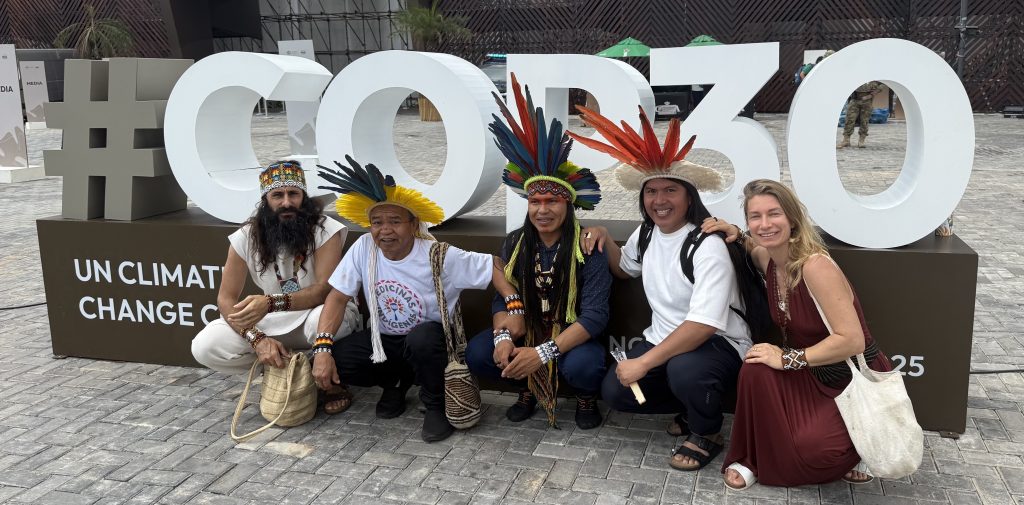
We just came back from our visit of COP30 in Belem, the UN Climate Change Conference. It was a great honor for us to accompany our Yawanawá elder Pai Nani and his sons Paka and Ushunawa in representation of the Yawanawá tribe to this event.
The COP is an annual climate conference (since the first convention in 1995) and reviews national contribution to mitigate climate change and leads negotiations on how to meet international treaties like the Paris Agreement (which was a international landmark treaty signed by 195 countries and agreed the ambition to limit global warming to a maximum of 2C).
Indigenous people are the guardians of the rainforest and consequentially are a key actor in the fight against climate change.
As a fact, indigenous protected areas of the Amazon rainforest experienced just 1/3 the amount of deforestation compared to non-protected areas.
The Yawanawa cosmovision and their spirituality are based on a deep connection to nature and the animals of the forest. With the loss of their culture (which we are experiencing right now) we also see an increase in the adoption of western culture and a loss of their connection to the forest.
Hence, rescuing their culture is the key to preserving their guardianship of their territory and the wider rainforest. One reason why we support the School of Yawanawa Tradition led by Pai Nani.
Together with our UK partner organisation AYNI Alliance we are working on increasing the voice of indigenous people in front of global decision makers. Indigenous people are the most vulnerable and impacted groups of climate change but also the once that are most underrepresented. Hence, our mission at the COP was to let the Yawanawa be heard and to give them the opportunity to share their perspective on climate change which is deeply rooted in their traditions and unique cosmovision.
Below a short report of what we have experienced and links to some video recordings of our delegation and their perspective.
COP30 report
This was the second time we accompanied Pai Nani to the COP. Last time in Dubai for COP28, we noticed a clear separation of “indigenous issues” that were discussed mostly in the Indigenous Pavilion, which was a seperate building where many Indigenous gathered speaking to each other about their challenges. However, the people of power in blue shirts and white collars were absent, holding their negotiations and discussion in their own bubble with only a very limited indigenous representation.
This years COP was communicated as more integrative for indigenous voices, and certainly number wise it was: more than 2,500 indigenous people attended the event but only 360 of them received access to the blue (official) zone. On the contrary, 1 in every 25 participant were a fossil fuel lobbyist, outnumbering any single country delegation. There again was a dedicated area for indigenous people. This time they put up a little village called Aldaia COP. Separated from the formal COP side, in a rather poor area of Belem indigenous groups met and topic related presentation were hold, also visited by the indigenous minister and other political leaders at times. However, very little other participant groups other then indigenous people were to find and the wider business and political community weren’t present (for reasons of unawareness or disinterest we believe). The energy was at times tense at this COP and planned demonstrations got out of control and violent as well for example when indigenous people storm the blue zone. Given the fact that indigenous people’s land has been violated, misused and disrespected from extractive industries for such a long time, this riot was possible foreseeable. We also think that the geographical separation of the indigenous vs. western hubs poured fuel into the fire.
The treatment of indigenous people, especially in the blue zone was a little shocking. Wherever we appeared we had a little crowd of people around us making pictures without asking at least for the name of the tribe – which in itself shows a general interest for indigenous people but little interest to really understand. It shows a general trend we are observing that indigenous people and culture are becoming something trendy but that there is a lack of interest to really understand whats behind the Koka (feather crowns – that were on sale for everyone in the Aldeia). We met Sonia Guajajara and COP Presidency André Corrêa do Lago in the blue zone area and introduced them to elder Pai Nani. They were open to a pictures but sadly not for any words with him.
What we found this time was an improvement, but still a similar story: even if the government committed to unprecedented indigenous representation which led to 2,500 indigenous people attending the summit, only 14% (360 individuals secured accreditation for the Blue Zone, the restricted area for official negotiations (which even if they are taken place in the same space are not open to everyone and almost impossible to attend). On that note, we like to also report how difficult it was for us again to receive badges to the blue zone (which were traded for thousands of Euros during the event just to get access), find accommodation (hotels charged up to 15x of the normal price) and give our Yawanawá a voice through speaking slots.
Outcomes for the family:
Despite the challenges, we personally were satisfied with what we could achieve for the family:
- We managed to access the blue zone of the event and could start fruitful conversation with foundations and business leaders
- Pai Nani and Juri spoke in front of business leaders at an event at the Climate Action House. A short recording from the event here
- Ushunawa spoke in front of young climate activists at an blue zone event (see here)
- Paka was speaking at Extreme Hangout and playing saitis at an event called
“If trees could talk”, see here - Pai Nani gave an interview for a short video with film maker Levison Wood under the series “Watch for Impact” which you can watch on the platform waterbear here
- Pai Nani was interviewed for austrian channel ORF – you can find the full article here
- We had a great talk about “The Future is Ancestral” at Hub Culture, details here (Video still to come)
- Pai Nani privately met musician Pinduca– his personal highlight of this journey (which seems a bit off topic, but in fact was a big gesture of inclusion and respect for indigenous people – which even in Brazil is not a given)
Outcomes from the COP negotiations:
- The Final negotiation text again deliberately avoids language on phasing out coal, oil, and gas. Even when it looked in reach with over 80 countries,supported a “roadmap” for transitioning away from fossil fuels, this was blocked by the Arab group and other oil producers, notably Saudi Arabia.
- 10 new indigenous territories were demarcated. 187,400 hectares of the Yawanawa territory has been already demarcated formally in 2023. This means the ownership of the land is not with the indigenous tribe but federal government. However, it gives formal land rights, recognition and as Pai Nani stated “right to remain” to the territory. Very positive is to mention that the Protection of Indigenous lands is now seen as an effective, evidence-based climate strategy.
- A voluntary plan to curb fossil fuels, a goal to triple adaptation finance and new efforts to “strengthen” climate targets
- 6.7B $ were pledged to go to the new Tropical Forests Forever Facility (TFFF), which is designed to provide long-term, performance-based financial rewards to countries that successfully conserve and expand their tropical forests.
- 1.8B $ were pledged to secure indigenous land rights (renewed Forest and Land Tenure pledge)
- There has been and agreement to triple the amount of financial resources allocated to climate adaptation in developing countries by 2030
Finally, we like to speak out out gratitude to the family of Pai Nani for their trust and collaboration and all Yawanawá for the service they do to mother nature and the protection of the rainforest. We also like to thank our supporters and everyone who donated towards this project.
For more videos and reporting follow our instagram channels: @anatta_sensorium and @aynialliance